


Artificial Intelligence
On-Device AI: Smaller, More Private, Faster
Running AI models on phones and laptops, helped by quantization and NPUs, improves privacy and responsiveness, but it comes with real limits.
Technology & cybersecurity magazine
Language models, RAG and on-device AI, explained simply and precisely.
Practical defences: passkeys, zero trust and server hardening.
From artificial intelligence and networks to cybersecurity — clear analysis and practical guidance in Persian and English, so security and technology are within everyone’s reach.
Start readingRunning AI models on phones and laptops, helped by quantization and NPUs, improves privacy and responsiveness, but it comes with real limits.
The newest pieces — search, or filter by topic.
Running AI models on phones and laptops, helped by quantization and NPUs, improves privacy and responsiveness, but it comes with real limits.
A practical guide to DNS: resolvers versus authoritative servers, common record types, TTL and caching, reading dig output, DoT and DoH, DNSSEC basics and troubleshooting.
Retrieval-augmented generation (RAG) lets a language model look things up in your own sources before it answers. Here are its parts, trade-offs and common failure modes.
Passkeys replace passwords with public-key cryptography and make phishing far harder. Here is how they work and how to adopt them as a user or site owner.
Phishing remains one of the most common ways in. This checklist covers warning signs, protective habits, what to do after a click, and SPF, DKIM and DMARC basics.
Prompt injection is one of the most important threats to applications built on language models. This article explains its forms and the practical layers of defense.
A practical look at HTTP/3 and QUIC: head-of-line blocking, faster handshakes, connection migration, 0-RTT risks, firewall considerations and how to check support.
Zero trust means access is decided by identity, device health and context, not by being on the internal network. Here is a pragmatic adoption path for small organizations.
What edge computing is and why it matters, how CDNs, edge functions and on-prem edge differ, real use cases, trade-offs and a simple framework for deciding.
A quantum computer will not replace your laptop, but it could threaten today's cryptography. An honest tour of the core ideas, the limits, and how to prepare.
From automatic updates and key-only SSH to a default-deny firewall, logging and tested backups: the baseline steps for securing a Linux server.
Comparing WireGuard, OpenVPN and IPsec/IKEv2, plus DNS leaks, kill switches, provider trust, and how a VPN differs from Tor and HTTPS, for a sensible and legal choice.
No articles match your search.
Each section is a focused collection of practical articles.

What is changing in technology, from quantum computing to edge infrastructure — analysed calmly, without the hype.
Explore section
Language models, RAG, on-device AI and the practical side of machine learning.
Explore section
From passkeys and zero trust to AI security: defensive guidance for people and organisations.
Explore section
DNS, HTTP/3, VPNs and network design — how the internet really works under the hood.
Explore section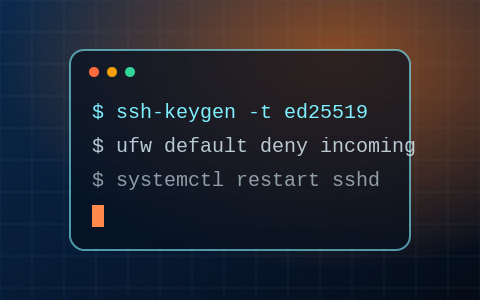
Checklists and step-by-step guides for hardening accounts, servers and small teams.
Explore sectionThese figures are static sample values, not live prices. They only demonstrate the interface.
Loading…
The README explains how to connect a real data source.